1. University campus – a “city within a city”
Mariana Cernicova-Bucă
The university as a reality of the modern world has a millennial history. There are historians that trace the roots of the idea of university back to the schools of antiquity (Peters, 2019). However, for what today we recognize as the institution capable of transforming, through a sustained and long-lasting educational approach, an ordinary person into a professional with skills, knowledge and self-awareness, the traceable history of the university starts with Bologna, in 1088 (Verger, 2019; Rüegg, 2011). The debates on the multiple changes that the university has experienced throughout its evolution are fascinating, reflecting society’s visions of this unique institution through the effects it has on the existence of the community to which it is addressed. In the 21st century, the overwhelming majority of countries in the world have a higher education system, with at least one university (Valero and Van Reenan, 2019).
The university is referred to in association with metaphors or epithets to signal current perceptions of the institution: “ivory tower” (Etzkowitz et al., 2000), entrepreneurial university (Clark, 2004), student-centered university (Wright, 2011), postmodern university (Aviram, 2010; Barnett, 2010). Peter Drucker even predicted the “death of the university” (Marmolejo et al., 2007), starting from what French sociologists call the „demonetization” of diplomas (Millet and Moreau, 2011) or from the democratization of the access to highly qualified professions by breaking the monopoly held by universities on training specialists and transferring vocational training to other types of skills providers. The debates lead, to the limit, to the dismantling of the term “university” through a big-bang-like evolution, to replace uniqueness with something that would be called “multi-versity” (Kerr, 1963; Krücken et al. 2007) or even “omniversity” (Bassett, 2021; Goetze, 2021). Beyond the mentioned controversies, beyond the attempts to define or redefine what a higher education institution means today, universities remain a constant of the societal environment, possessing the incredible capacity to simultaneously address the immediate and concrete needs of society, but also humanity’s projection of a distant future, marked by progress and innovation (Boulton and Lucas, 2011).
Regardless of the manner in which they came into being, of their profile or their anchoring on the globe, universities are made up of three interdependent parts, as Martin Wilhelm and Judith Elbe admirably define, speaking about the future of the university campus (Jensen, 2009): the educational and research institution (with its departments, employer and representatives), the academic community (made up of students, professors and administrative staff) and the university spaces as “habitats of university members”, with their built manifestation. The development (and management) of the university requires an integrated approach of all three components. Even when the institutions are decoupled from their physical materiality, university space – including in its virtual forms – represents a legitimate subject of study. In this space (which is wider than its geographical borders) a miracle occurs: new knowledge and innovation appear, generations of specialists are formed in a multitude of fields, capable of contributing to social development. This university space is designated by a word that, at least for now, is less controversial than “university”: “campus”.
The notion of campus associated with academic life entered Romania after 1990, through the influence of literature specialized on higher education in Europe and, especially, in the United States. The dictionary definition explains the word as referring to a “university complex comprising buildings and facilities for education, research, housing, leisure, etc.” We owe to Paul Venable Turner the attestation of today’s meaning for “campus” as the territory on which university buildings are located. He identifies the use of the term in the American university sphere in the 18th century (Turner, 1984). Turner also talks about the campus as a community that can be understood as “a city in a microcosm”, understanding by this not only the urban essence of the university campus, but also the relationship between the inhabitants of this unique space, which leads to the transmission of knowledge from one generation to another and to the production of new knowledge. Continuing this idea, Scholl and Gulwadi (Scholl and Gulwadi, 2015) propose that campuses, including green spaces between buildings, are entities to be approached holistically. They are “learning spaces” on multiple levels of interaction between people, between people, on the one hand, and the natural and built environment, on the other, respectively between visible and invisible networks that are structured at the university campus level.
As a form of organization, the campus is presented as a “city within a city” – with different possible configurations, from an area surrounded by walls, such as a monastery protected from the intrusion of the outside world to open space, interwoven into the structure of the host city, with which it alternates in mosaic and fluid ways (Den Hejder and Curvelo Magdaniel, 2018). The relations between campus and city encounter multiple variations, depending on the geographical area. In the United States of America, for instance, there were universities that preceded the existence of a city. The urban community was built later, complementary to the academic institution, as it was the case at Harvard, Princeton, or Berkley (Wilhelm and Elbe, in Jensen 2019). In Asia, cities superimposed on the university campus, in a technological cluster, have been developed (Den Heijer and Curvelo Magdaniel, 2018). The best-known models in Europe, however, are variants in which campuses and cities have numerous points of contact and overlapping, even if the academic area is located on the periphery or has natural or built dividing barriers (Jensen, 2009). The university is – and, as Ortega y Gasset put it – must be “open to the whole reality of its time”, that is, to participate in the life of society “as a university”, as an entity with specific valences, potential and uniqueness (Ortega y Gasset, 2010, p. 76).
University-city relations are evolutionary and complex (Brennan and Cochrane, 2019), but the presence of a university in the city is associated with dynamism, attractiveness, economic competitiveness, and vitality (Glückler et al., 2019; Valero and Van Reenan, 2019; Curvelo Magdaniel 2013; Harris and Holley, 2016; Pastor et al., 2012; Trani and Holsworth, 2010). Moreover, the presence of a university confers prestige and increases the visibility of a city. The anticipation of such impacts led, in 1990–2020 Romania, to the doubling of the number of higher education institutions compared to the period 1980–1990 (Cernicova-Bucă, 2010). Of course, the desire of local communities in key Romanian cities to attract the socio-economic benefits of university presence was not the sole factor driving this growth. The change in society’s conception regarding access to education, the requirement for new specializations, the harmonization with the European system, etc. also played significant roles (Millet and Moreau, 2011; Florea and Wells, 2011).
In the motivation letters submitted by local communities to the Romanian Parliament to lobby for laws establishing new universities, no concrete economic effects were estimated. The test came unexpectedly. The health crisis caused by the COVID 19 pandemic demonstrated what until 2020 was estimated only as a theoretical exercise: the withdrawal of the university from public life led to considerable losses (Valero and Van Reenar, 2010). According to media, in Timișoara alone, the absence of university activity during the lockdown period (2019–2020) led to a loss of over 150 million euros (Iszlai, 2021). Universities are not only an important employer, a magnet of attraction for young people who come to acquire a certification opening access to a higher social and economic status, but also a consumer of local products and services, as well as an irreplaceable partner in development-innovation strategies. The presence of the university in a region allows the articulation of the quintuple helix model of development, which brings together the established series of university-industry-government spheres, to which civil society (Matei and Dobre, 2021) and the environment must be added (Carayannis and Campbell, 2010). Only such a model leads, according to the researchers who developed it, to sustainable development or, with a term that is gaining increased ground, to sustainability for large urban localities (Carayannis and Campbell, 2010; Carayannis et al. 2021; Switzer 2021).
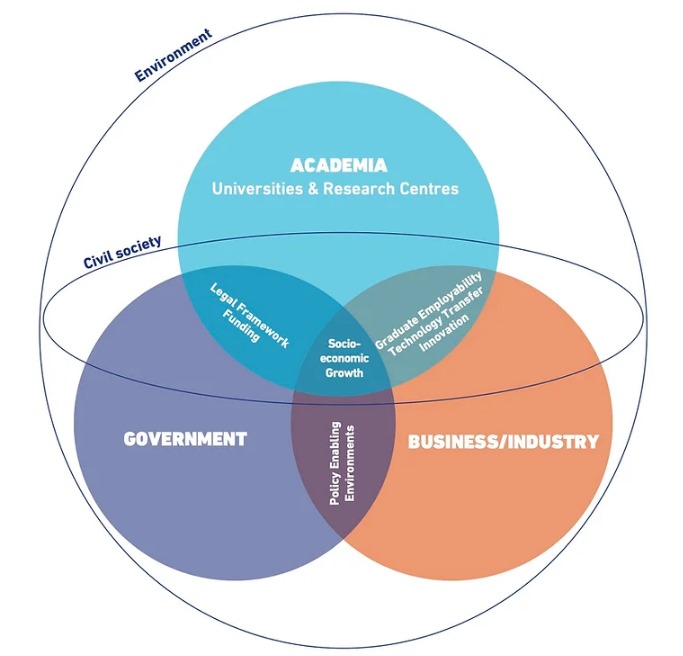
Figure 1. The quintuple helix model, apud C. Switzer
Returning to the topic of university campus and its anchoring in the urban environment, it is important to identify the functions that are shared by the city and the campus. A complex and mature campus fulfills as most essential functions (Den Heijer and Curvelo Magdaniel, 2018) the following:
• The academic function of education and research makes the campus a distinctive “oasis” of the city.
• The residential function, as housing for students, administrative and/or teaching staff.
• The function of space for leisure and relaxation: sports, cultural, dining facilities.
• The economic function – in which contact occurs with partners providing support services for the academic environment.
• The infrastructure function – ranging from pedestrian accessibility to car parks.
From country to country, from region to region, the above-mentioned functions manifest differently. In Norway, for example, the residential function does not belong to the university campus, but is carried out through a separate structure, which recurrently cooperates with universities. Housing, therefore, remains an option that students access independently of their study path. Most European universities, however, own and administer student dormitories. Their existence is perceived and presented as an advantage in educational marketing. In the United States of America there are universities that, given the large geographical distance between different educational and residential buildings, offer shuttle buses, making it more accessible to navigate the academic space. Moreover, there are voices advocating in favor of the idea that living on campus is an “integral part of the educational path” for students (Yanni, 2019), continuing the Humboldtian idea that the campus is (more) protected from the (negative) influences of the outside world (Boulton and Lucas, 2011).
Beyond the ability of a campus to meet the current needs of students and teachers for everyday work, it remains valid to maintain broader relationships with the city, at a functional level. Even in the microcosm state claimed by many researchers, the campus remains part of the urban galaxy, bound to comply – even partially – with the rules of the neighborhood. Campus-city relationships are constantly negotiated and re-created, as extensive research related to this topic reveals (Mohammed et al., 2022; Den Heijer and Curvelo Magdaniel, 2018; Jensen, 2009; Goddard and Vallance, 2014). Both the university campus and the city have resources that can be shared, thought of as complementary, in a continuum making the social, cultural, economic, and sports life in an area to be positively perceived by those who inhabit that space and perceive it as “theirs”. For students, the campus is the main place for socialization, learning, access to study and research, prospecting the possibilities that professional training opens, practicing (safely) the multiple roles they will have to fulfill once they have completed their training path (Brooks, 2018). The campus offers both formal learning and informal variants for the accumulation of experiences, skills, knowledge, vital for autonomous life. This leads researchers to view campus life as a living laboratory, where history, architecture, mindsets, values, lifestyles, and learning provide endless opportunities for inspiration.
The history of higher education in Romania begins rather late by comparison to Western Europe, even if, according to some sources, university-like structures can be identified on the current territory of the country dating back to the 16th-17th centuries (Florea and Wells, 2011; Yamamoto, 2018; Ciurel, 2021). The interrupted tradition of the Michaelian Academy (founded in 1835) is taken over by the University of Iasi, now Alexandru Ioan Cuza University, named after the ruler who founded it in 1860, one year after the Union of the Principalities, thus laying the foundations of Romanian higher education. Since then, Romanian higher education has recovered its growth rate, managing to connect to the European system by joining the Bologna process, through its contributions to defining the European Higher Education Area (Florea and Wells, 2011), respectively through the effort of Romanian universities to enter the ranking systems in the world, which position them perhaps not among the top 100, but, for those who dare to go through the exercise, in the honorable area of comparisons with the most prestigious universities in the world in terms of quality of education and research.
In the western part of Romania, the history of higher education starts also after a union, but only in the 20th century. The local Banat community had pleaded, at the border between the 19th and 20th centuries, with the Ministry of Education in Budapest for an engineering school, but the memo was treated with refusal. The union of Banat with Romania brought this desideratum to life. Practically, one year after the completion of the union following the establishment of the Romanian administration in this region, the arguments for the need for a Polytechnic School were heard and Ferdinand I signed the Royal Decree 4822/11.11.1920 founding the institution. The school was created according to the principles of the Decree-Law “relative to the establishment and organization of Polytechnic Schools in Romania” (June 19, 1920) which stated, in Article 1: “Polytechnic schools are institutes of higher technical learning assimilated by degree of culture to universities.” (Vâlcovici, 1930). In his plea for the establishment of the school, the then mayor of Timisoara, Stan Vidrighin, also announced the municipality’s willingness to mobilize significant sums of money and an adequate territory for the erection of the future “temple of Romanian science” (Vâlcovici, 1930), so necessary for the economic, social, and cultural development of the region. The school opens its doors to the first students in a space allocated for this purpose, but which represented only the mustard seed from which sprang the vigorous and powerful institution of today. Three years later, King Ferdinand would inaugurate the Politehnica university campus, designed in a pavilion system, with spaces for education and research, but also with much-needed residential capacities for students and teachers. Recalling the “Sisyphus work” involved in building the Politehnica, the second rector of the institution, Victor Vâlcovici, who also founded the university campus, identified the evolutionary steps taken as follows (Vâlcovici, 1945):
“The first phase is that of the birth of the institution. It has a somewhat romantic character, especially in the period preceding the actual birth, the period of spiritual gestation and contact with political factors. The period that follows includes the political decision of foundation, the law and the first impulse.
The second phase, much more important in the life of the institution, is the phase in which the institution begins to come into being, starting from the embryo and tending to take the shape and dimensions of the institutions with which it is approved.
Finally, phase three is the phase of the permanent regime. The institution has reached a form of maturity, of formed stability, and follows the quiet evolution of a regime set up to produce.”
Anticipating the centenary of Politehnica, in 2020, Victor Vâlcovici expected that the future generations whose turn would come to concern themselves with the fate of this viable institution would “struggle with the difficulties of their times”. But even so, he was convinced that the future would belong to a top institution, with scientific prestige and seriousness comparable to those of the best European polytechnic institutes.
King Ferdinand I attended the inauguration of the Mechanics pavilion, on his first visit to Banat since the region joined Romania. In his speech, the king uttered the words that have remained as the motto of the institution: “It is not walls that make a school, but the spirit that reigns within it.” The encouragement to strive for academic excellence, beyond the physical materiality of the buildings and laboratories that was and is needed to train future specialists, immediately followed. The speech continues: “I firmly believe that young people and teachers will know how to hold this spirit high.”
The Politehnica campus grew steadily: in 1927 the first dormitory of Politehnica was inaugurated, following the plan conceived by architect Duiliu Marcu, who also designed the project for the Mechanics pavilion. In 1930, the building housing the canteen, located next to the dormitory, with a capacity of 450 seats, was completed. This put an end to the use of improvised spaces in the city since the school developed its own infrastructure. In 1937 the sports base “Politehnica” was inaugurated. In celebrating the first quarter of the centenary, Victor Vâlcovici listed the numerous laboratories of the time, with their facilities and with what today one labels as competences developed in such spaces. The growth of the real estate assets was constant, reaching, in the first quarter of the 21st centenary, over one hundred buildings, bringing a significant urbanistic contribution to the development of Timisoara, especially in the central area. The residential area, hosting over 6,000 students, is divided between the two historical dormitories, in the immediate vicinity of the Mechanical Pavilion, and the part generically known as the “Student Complex”, consisting of the buildings erected between 1960–1980, according to the model-type of same height buildings, where, besides the Politehnica dormitories, there are also the dormitories of the comprehensive university, bearing today the name “West University of Timisoara” (UVT).
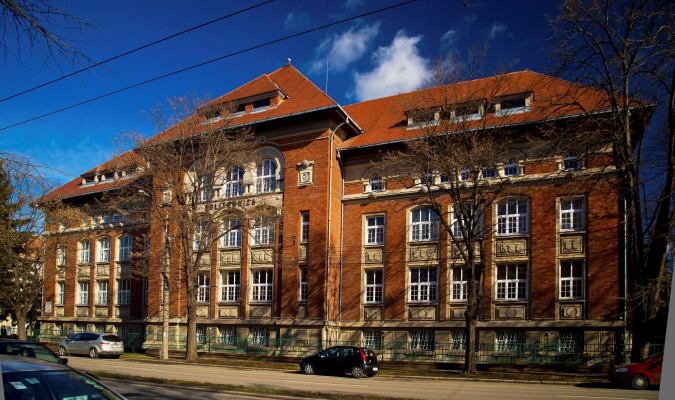
1.1 The Mechanical Pavilion, a century later from its inauguration.
The seven UVT dormitories from the Student Complex were completed with three new residential units, located outside the perimeter of the campus. The growth of the number of students and the diversification of programs led to the necessity to enrich the real estate patrimony of the university, with the acquisition of new spaces for teaching and research activities, as well as for accommodation purposes. In addition, the campus section developed by UVT implemented a proposal formulated at the end of the 20th century, namely the erection of the Student Church. The former chief architect of the city, Radu Radoslav appreciates that through this architectural intervention, represented by the “Students’ Church” (dedicated to the Annunciation, completed in 2000), “the spirituality of the university environment was consolidated” (Radoslav, 2023).
According to Radu Radoslav, who cites various documented proposals for zonal urban plans, after 1990 there was a proposal of the municipality to move the campus outside the city, invoking a variety of motivations (Radoslav, 2018). “The utopia has not been realized” – stated the architect, who lamented, instead, that the uncontrolled emergence of business in the student residential area led to a lively nightlife and the cancellation of the possibility of relaxation and study. The feature that the architect identifies is “turbocampus” (Radoslav, 2018), with areas that student life should exclude from the proximity of young learners. At the 100th anniversary of the campus, the “turbo” stage became, however, history. The joint intervention of local authorities on the regulation of commercial activities and that of universities to ensure the comfort of student life contributed to the maturation of the campus fulfilling the five functions identified by Den Heijer and Curvelo Magdaniel as significant (Den Heijer and Curvelo Magdaniel, 2018). For the 21st century Politehnica:
• The buildings of the ten faculties, library, research centers and conference center allow the campus to play the distinctive academic function of education and research in the city.
• Through the sixteen student dormitories, plus two short term dormitories, the residential function is validated.
• The function of space for leisure and relaxation is fulfilled by the two sports bases, the six dining units and the cultural areas inaugurated in 2023.
• The economic function – in which contact with partners providing support services for the academic environment occurs – is developed throughout the campus.
• Finally, the infrastructure function has also undergone substantial transformations, from the arrangement of parking lots to rental stations for bicycles or electric scooters.
To the residential buildings one must add the Student Polyclinic located on campus, which offers a wide range of medical services. In everyday life during the academic year, students can access, within a radius of one kilometer, all the services they need, without having to leave the campus territory. That is why this “city within a city” (or the “oasis of youth”) deserves special attention. Students do not use it as a sleeper only, but also as a place for living a life close to the one they will have after graduation, when most of them will opt for independent housing. Therefore, learning (even informally) to face the various challenges of everyday life must find its place among current concerns.
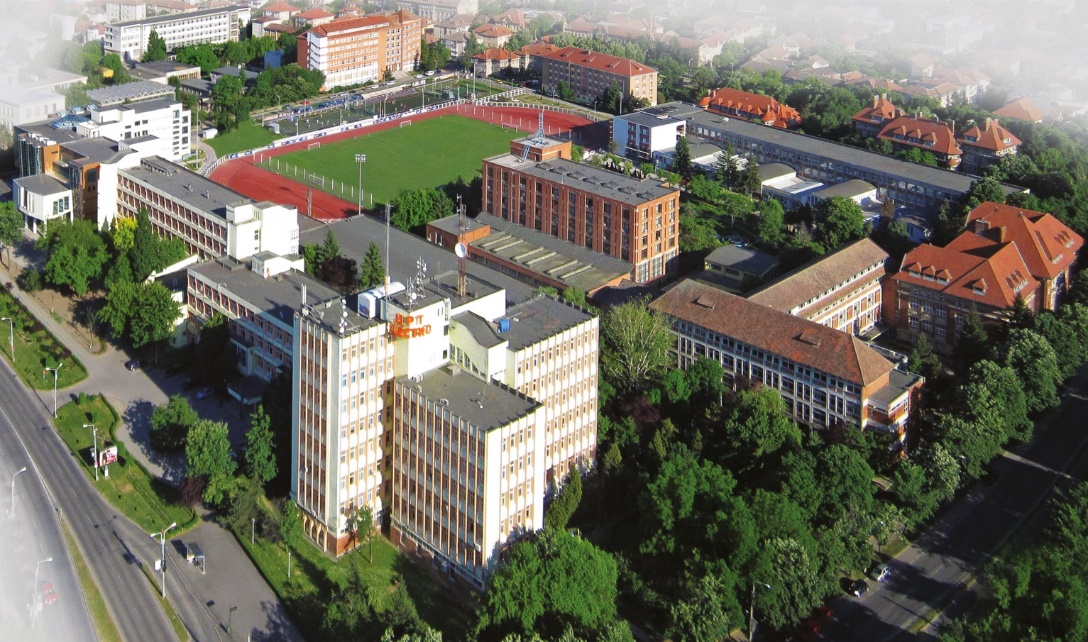
1.2 Student campus, historical part
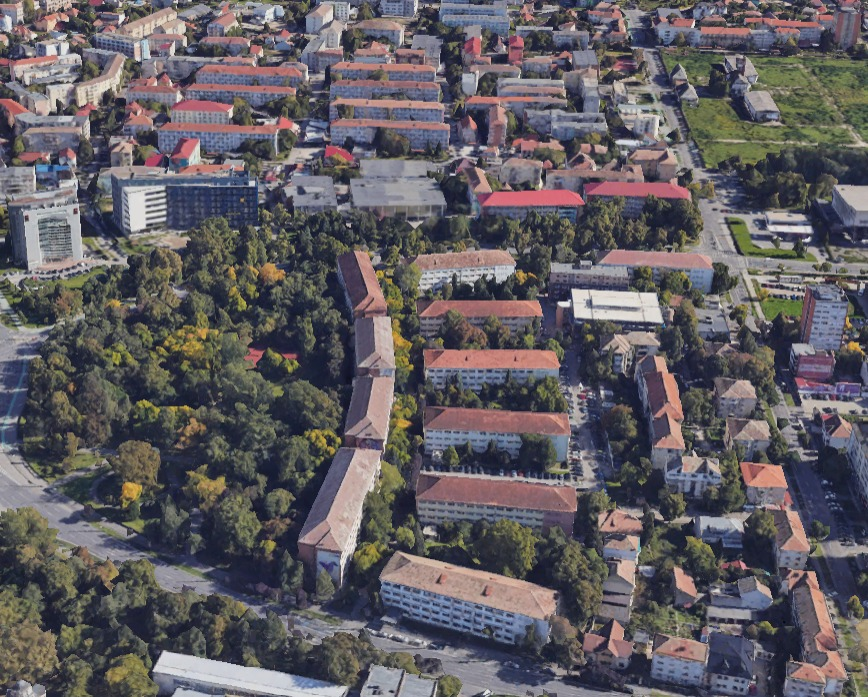
1.3 Student campus – main residential area
During this period of development and transformation, another event occurred: polytechnics in Romania adopted the name “university” (replacing the previous terminology: “school” – a term reserved for pre-university education institutions, respectively “institute” – a term that remained in use for research institutions). Today’s Politehnica University Timișoara proudly bears its name after passing through the variants “Polytechnic School” (1920–1948), “Polytechnic Institute of Timisoara” (1948–1970), respectively “Polytechnic Institute Traian Vuia of Timisoara” (1970–1991), “Technical University of Timisoara” (1991–1995), respectively Politehnica University of Timisoara. The structure of study programs has changed, new specializations have appeared, others have disappeared, following trends in Romanian and European technical higher education (Cernicova-Bucă et al. 2021). The concern for the education and welfare of students has remained a constant issue, according to a concept widely spread in the field of higher education, which puts universities in the position of acting “in loco parentis” to ensure the harmonious development of the young generation (Macintyre, 2003).
Even if we have presented in detail the campus belonging to Politehnica, which was the place of the intervention for implementing the principles of sustainable development, described in the following pages, it is worth mentioning that the academic Timișoara city also presents other forms of campuses. Created in 1945 (initially in the structure of the Polytechnic), the agronomic education in Timisoara has developed strongly not only in the direction of academic programs, but also as a complex of buildings that brings together, on the same land, educational spaces, laboratories for scientific research, utilities for micro-production activity, spaces with social destination such as dormitories and canteen, sports fields, and recreational activities. Currently known as “King Michael I” University of Life Sciences in Timisoara, the institution is located on the outskirts of Timisoara, surrounded by a dividing fence, following the model of the most modern university campuses in Europe in the 1960s and 1980s, when the Agronomy complex was built. In 2012 a student church was built on the territory of this campus, also in the logic of completing the function of the territory as “city within city”.
As for the Victor Babeș University of Medicine and Pharmacy (UMF) in Timisoara, also created at the end of World War II, it had for a long time a smaller real estate dowry, using the buildings of the former Roman-Catholic high school “Banaţia”, with teaching-research area and residential area. In 2024, however, the construction of a new university campus started in the peri-urban area, on the territory of Ghiroda commune. The project, which will take place on a plot of 21,000 square meters, provides for the construction of a building with amphitheaters, seminar rooms, conference center, an anthropological museum and an exhibition center, offices for teachers and scientific staff. The new campus will also have another building with a teaching role and a building with accommodation units, halls, and sports fields.
Literature quotes Winston Churchill’s words “We shape our buildings; thereafter they shape us.” Carla Yanni, in an extensive monograph dedicated to the history of housing on American campuses, explains at length how campus morphology reflects (and determines) mentalities, educational experiences and even specific professional flows, after graduation, for those who have shared the educational and residential space of a given university (Yanni, 2019). Curvelo Magdaniel analyzes thirty-nine campuses, highlighting the implications that the location of the student residential area in a protected oasis, respectively in an area intertwined with the city, carry with it, and leave their mark on student life (Curvelo Magdaniel 2013). Taking these into account, we recognize that the proposed analysis is appropriate to the described local, social, geographical, morphological context and that under different conditions – even in the other types of campus, briefly presented above, some of the interventions could yield different results. On the other hand, however, many of the actions reported in this endeavor to influence student housing and make it more sustainable can be safely replicated: students received them and viewed them at least with interest, if not with engagement.